
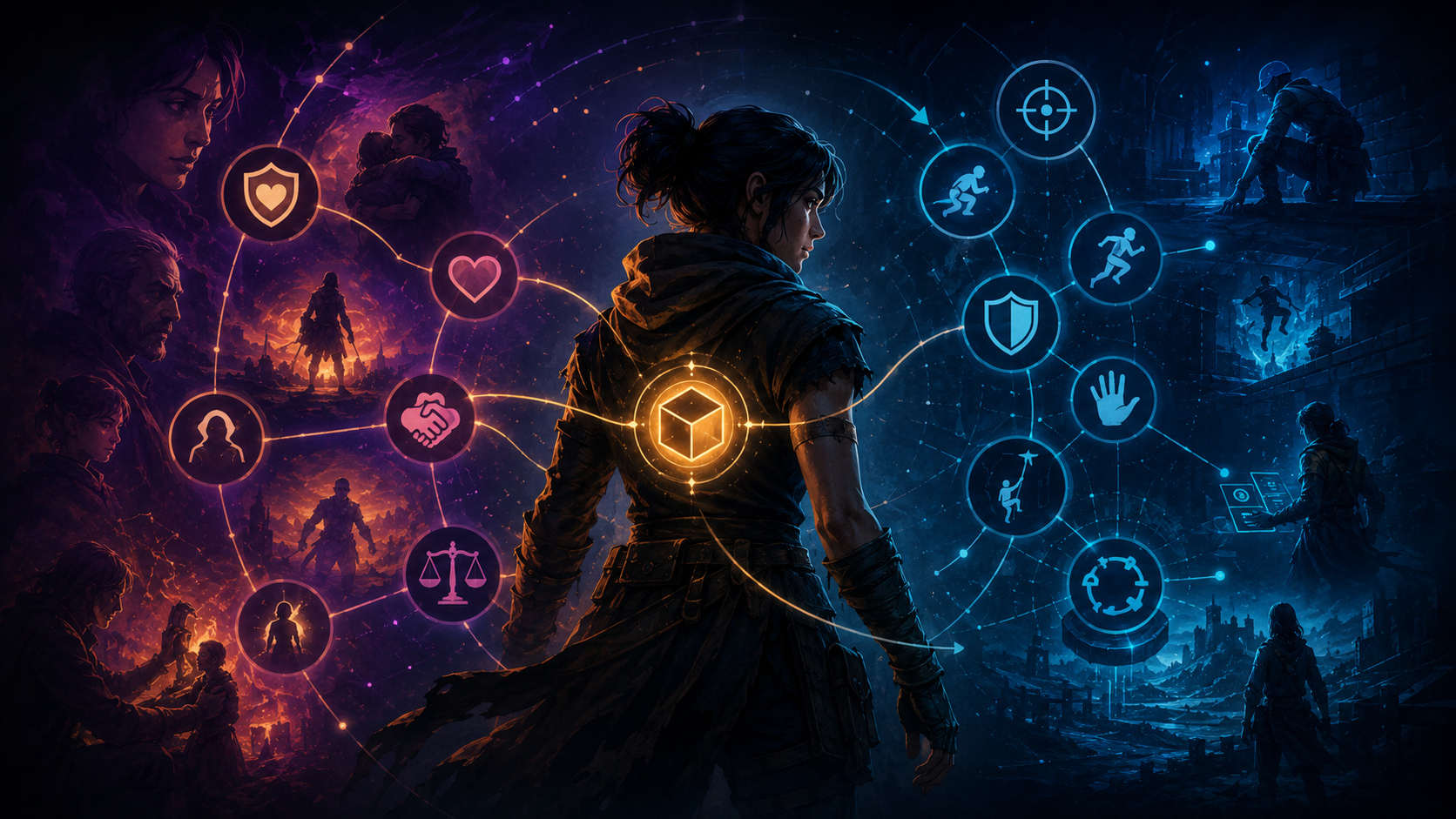
In 2007, a game designer named Clint Hocking coined a term that would change game criticism forever: Ludonarrative Dissonance.
It describes the jarring, immersion-breaking clash that happens when a game's story tells you one thing, but the gameplay systems force you to do another.
[Ludonarrative Dissonance]
Story says: "I must run to save my dying daughter!"
Gameplay forces: "Let's spend 3 hours collecting 50 hidden feathers."
If you want to design games that leave a lasting emotional impact, you must achieve Ludonarrative Resonance—where the player’s mechanical actions are the direct, logical expression of the character's inner narrative motivation.
Step 1: Establish the "Why" Behind the "What"
In bad game design, player objectives are arbitrary: "Go to point B because a waypoint marker appeared on your screen."
In great, character-driven design, the objective is the natural extension of the character’s internal motivation.
If your character is driven by a deep, obsessive desire for revenge, your mechanics should reflect that focus.
In Hotline Miami, the frantic, fast-paced, and highly lethal gameplay loops perfectly mirror the disorienting, drug-fueled, and violent psychosis of the protagonist. The player is not encouraged to pause, think, or plan; they are driven forward by a visceral, unstoppable compulsion that matches the character's mental state.
Step 2: Harmonize the Game Economy with the Narrative
Your game’s economy—how resources are gathered, spent, and valued—is a massive driver of player behavior. If your narrative claims resources are scarce, but your economy is overflowing with loot, your story loses all credibility.
Consider this mathematical relationship. If the narrative tension (Tn) requires a sense of extreme survival pressure, the resource drop rate (Rd) must scale inversely with the player’s current stockpile (Sp):
Where:
Rmaz is the maximum possible drop rate.
ß is a scarcity coefficient.
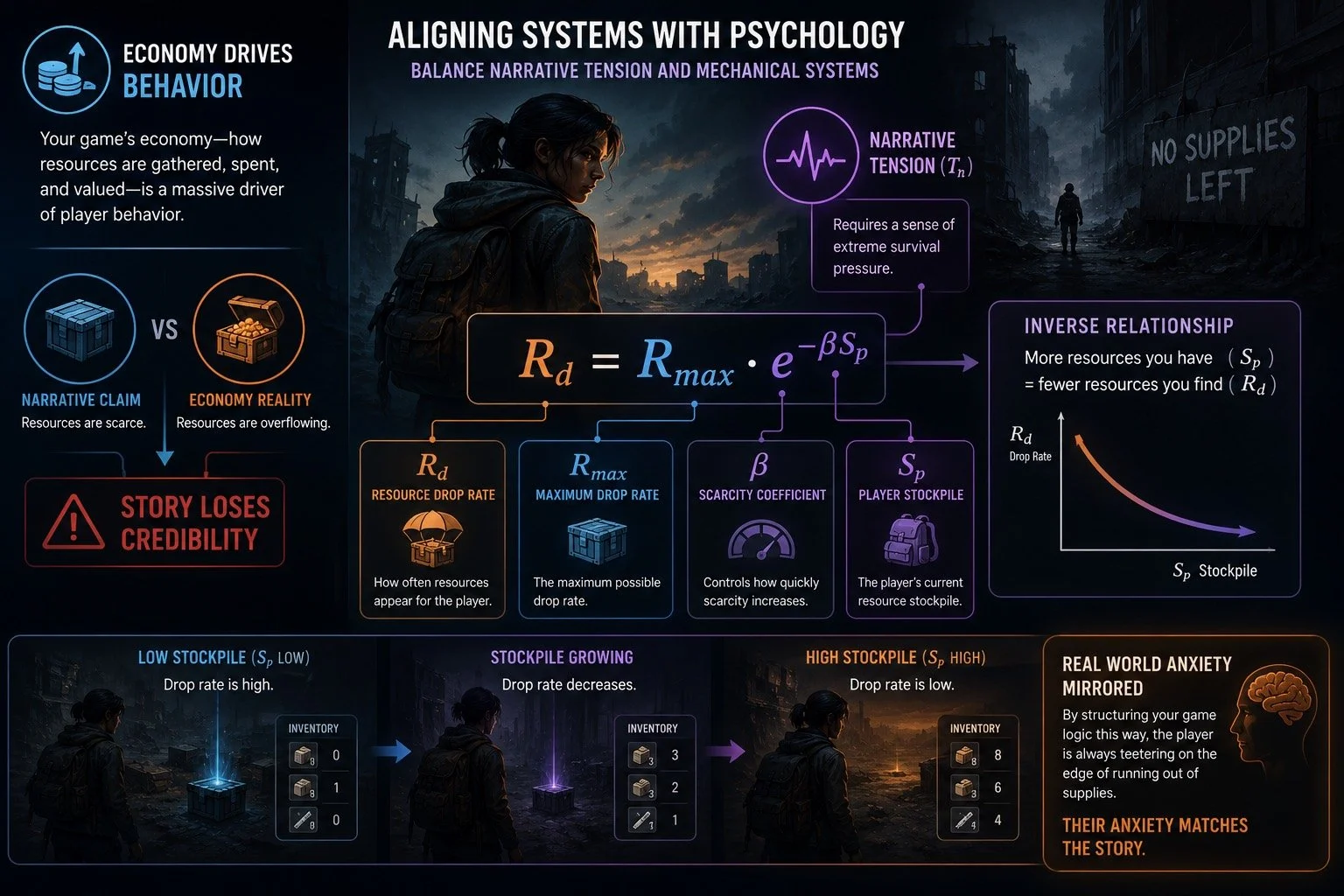
By structuring your game logic this way, the player is always teetering on the edge of running out of supplies. Their real-world anxiety perfectly mirrors their character's narrative desperation.
Step 3: Allow Mechanics to Evolve with Character Growth
A character's personal growth arc should never be isolated to cutscenes. As their confidence, trauma, or relationships change throughout the story, the actual gameplay mechanics should shift in tandem.
In Celeste, Madeline’s struggle with anxiety and self-doubt is directly represented by her mechanical dash ability.
When she eventually reconciles with her inner shadow self, her mechanics double—granting her a double-dash. The emotional breakthrough is felt directly as a surge of physical empowerment in the gameplay controls.
Achieve Perfect Harmony on Your Next Project
Designing a narrative that moves hand-in-hand with your code is the hallmark of a master craftsman. Skip the messy trials and start structure-first. Download our free Game Design Starter Kit today, which includes story-to-mechanics mapping worksheets designed to eliminate ludonarrative dissonance from your templates forever.