
What Are Serious Games? Designing Play Systems for Real-World Impact
Have you ever sat down with a video game and realized, hours later, that you didn't just play a system—you learned one?
For decades, society has viewed video games through a very narrow lens: as trivial, low-culture entertainment designed to distract us. But as a student of The Game Beyond, you are invited to look at games differently. Games are not mere toys. They are the first interactive mass medium in human history—complex digital ecosystems that give players direct agency over rule-based structures.
When we direct that agency toward real-world challenges, we step out of pure entertainment and into the field of Serious Games. From training surgeons and analyzing global economics to crowdsourcing solutions for terminal diseases, serious games are proving that play is one of our most powerful tools for solving human crises.
In this guide, we will demystify the discipline of applied game design, contrast it with superficial gamification, and explore the ethical responsibilities of building spaces of possibility.
1. Defining the Core: What Makes a Game "Serious"?
At its most fundamental level, a serious game is a game designed with a primary purpose outside of pure entertainment.
This does not mean the game is dry, boring, or lacks engaging mechanics. Quite the opposite: a successful serious game must feel incredible to play because it relies on the same "game feel" and reward loops that make commercial blockbusters so captivating. The critical difference lies in the intentionality of the systems.
In a traditional game, a feedback loop is designed to maximize retention or monetize attention. In a serious game, the loop is designed to mirror real-world dynamics. Consider this systemic relationship:
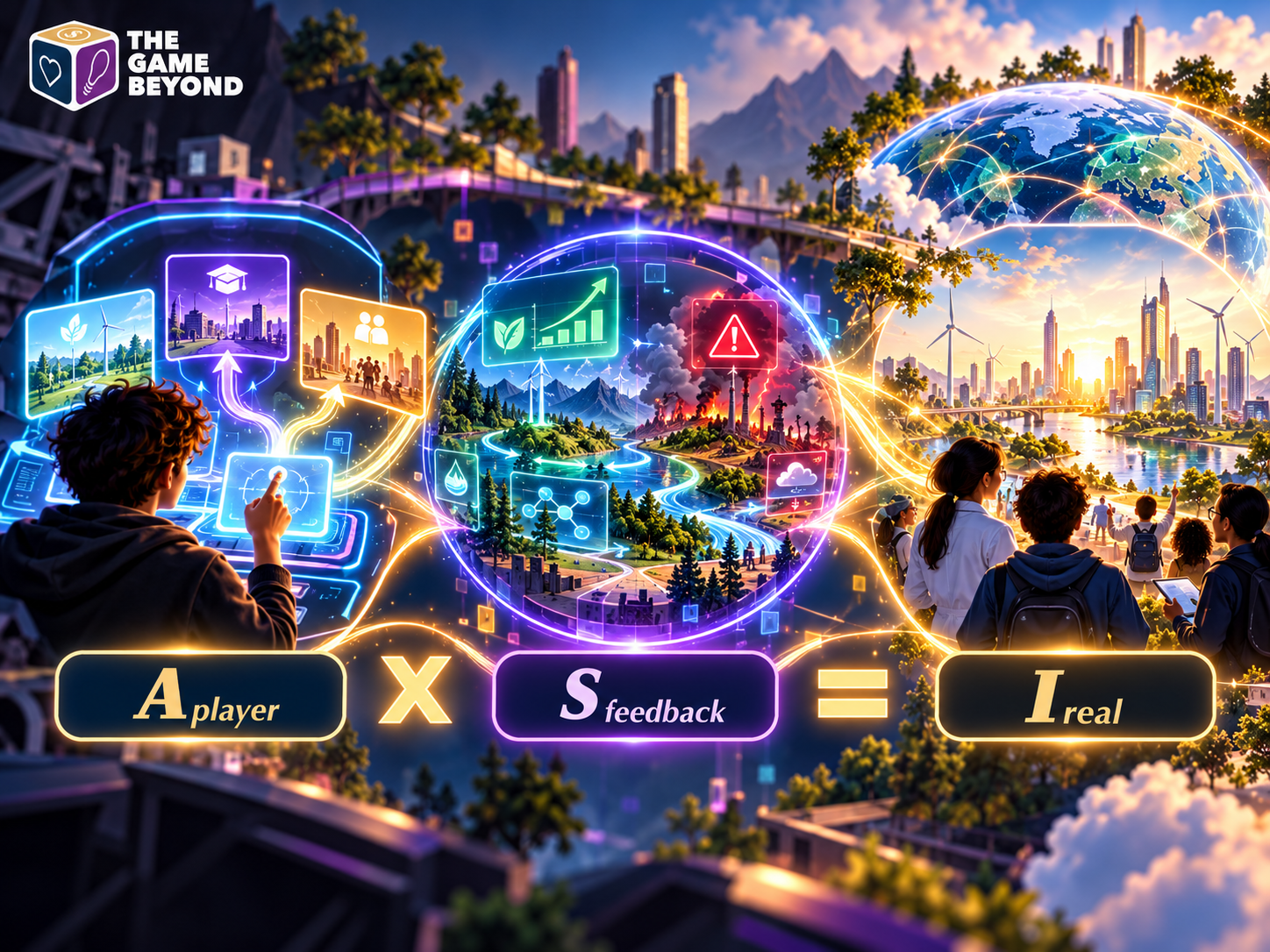
I real = A player x S feedback
Where:
I real represents the Real-World Impact or cognitive transfer.
A player is the Player Agency (the meaningful choices the player can make).
S feedback is the Systemic Feedback (how accurately and intuitively the game communicates the real-world consequences of those choices).
If your game limits agency or presents a false system of consequences, the transfer of knowledge fails. True serious games are built on rigorous systems thinking, translating real-world data and behavioral science into playable mechanics.
2. Serious Games vs. Gamification: The Skinner Box Trap
In the corporate and educational sectors, you will frequently hear the term gamification. It is vital for a professional designer to understand why gamification is fundamentally different from—and often inferior to—serious games.
Gamification is the process of taking an existing, unengaging task and slapping a superficial layer of game mechanics on top of it. This usually takes the form of points, badges, and leaderboards (the "PBL" triad).
This approach relies entirely on extrinsic motivation—prompting action through external rewards. In his famous lecture Visions of the Gamepocalypse, game designer Jesse Schell warned of a future where everyday actions—from brushing your teeth to buying food—are tracked by corporate sensors to award you arbitrary consumer points. While this "Skinner box" model can drive short-term interaction, it does not foster genuine learning or behavior change. Once the novelty of the badge wears off, the player's motivation collapses because the core task remains fundamentally tedious.

Superficial Gamification:
[ Tedious Task ] ➔ [ Thin PBL Layer (Points / Badges) ] ➔ Extrinsic Motivation (Temporary)
Serious Game Design:
[ Integrated System Simulation ] ➔ [ Authentic Player Agency ] ➔ Intrinsic Motivation (Lasting)
Serious Game Design, by contrast, builds a unified simulation from the ground up. It focuses on intrinsic motivation—the inherent satisfaction of solving a complex puzzle, mastering a system, or understanding a perspective. Instead of bribing the user with a gold star, serious games allow the player to manipulate the system’s variables directly and experience the logical consequences of their choices.
3. The Ethics of Play: Moving Beyond "Lazy Design"
Because games give players agency, they are highly persuasive. When we design a game's rules, we are setting the "laws of physics" and "moral truths" of that virtual universe. This power makes the medium highly vulnerable to misuse.
In The Serious Game Design School, we study the history of propaganda games—systems built to trick players into adopting a specific ideological mindset under the guise of free choice. Whether it is a government-funded military recruitment simulator or hate-group software, propaganda games succeed by hiding real-world constraints within seemingly objective game loops.
However, the far more common danger in modern game development isn't intentional propaganda; it is lazy design.
Lazy design happens when developers unthinkingly reuse default industry tropes and mechanical patterns without examining what those systems communicate.
Accidental Indoctrination: Think about how many modern shooters use specific cultural or ethnic groups as the default "enemy." When players are continually rewarded with headshots and achievements for killing a specific demographic without any narrative context or moral dilemma, the mechanics slowly train a subtle, real-world bias.
Mechanical Contradictions (Ludonarrative Dissonance): Consider the classic role-playing game trope where upgrading a female character’s armor stats visually translates to more revealing, sexualized outfits. When the system states that a character is heavily protected, but the visual affordance screams the opposite, the game communicates a mechanical lie to the player, reducing the simulation's authority.
As ethical designers, our goal is not to force a single, dogmatic point of view on our audience. Our goal is to build a fair, balanced space of possibility where players can experiment, fail safely, and discover systemic truths for themselves.
4. Case Study: How Foldit Tapped Global Cognitive Surplus
To understand the raw potential of applied game design, look no further than Foldit, a landmark serious game developed by the University of Washington.
For over fifteen years, biochemists struggled to map the crystal structure of an AIDS-related retroviral protease. Understanding this structure was a vital key to creating effective pharmaceutical treatments, but the molecular math was too complex for automated supercomputers to solve.
The developers of Foldit took this hyper-complex biochemistry problem and translated the molecular forces into intuitive, spatial interaction mechanics. Players did not need a degree in chemistry; they were presented with a 3D structural puzzle game where they could pull, shake, and fold protein chains. The game's score system directly reflected the thermodynamic stability of the molecule.
Within just three weeks, an international collective of gamers cracked the structural puzzle that had baffled world-class scientists for a decade and a half. By translating an abstract, overwhelming scientific problem into a polished spatial interface with clear mechanical goals, Foldit transformed a global cognitive surplus into active scientific progress.
Conclusion: Build Games That Matter
The Game Beyond is built on a singular, optimistic brand promise: Design Games. Change the World.
If you want to move beyond being a consumer of digital spaces and become an architect of human experiences, you must look past the superficial trends of the gaming industry. By studying systems thinking, player psychology, and ethical loop design, you can construct interactive experiences that solve real-world problems and leave players with a profound, lasting perspective.
Your journey from player to creator begins with a single, structured step.