
The Holy Grail of Immersion
We have all experienced it: that cognitive state where hours vanish in what feels like minutes. You are so deeply focused on a task that all self-consciousness, physical fatigue, and outside distractions melt away. Psychologist Mihaly Csikszentmihalyi defined this phenomenon as the Flow State.
In game design, keeping your player inside the "Flow Channel" is the difference between a project that is abandoned after ten minutes and one that leaves a lifelong impact.
Flow is not a random accident—it is the result of precise dynamic balancing between the Challenge of the Game System and the Skill of the Player.
Modeling the Flow State Formula
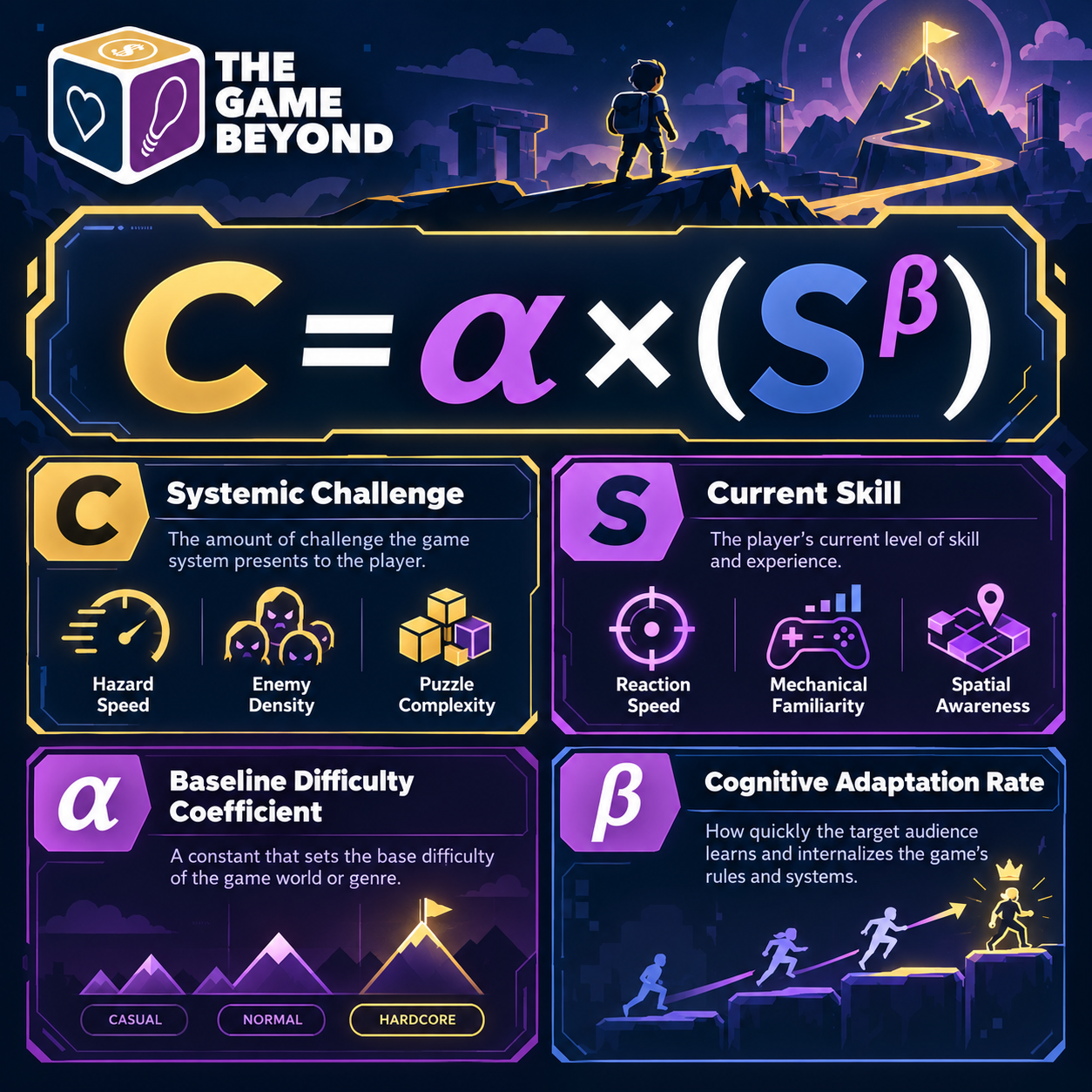
We can express the ideal flow state target mathematically in plain text as:
C = alpha * (S ^ beta)
Where:
C = Systemic Challenge presented by the game (hazard speed, enemy density, puzzle complexity).
S = Current Skill level of the player (reaction speed, mechanical familiarity, spatial awareness).
alpha = The baseline difficulty coefficient of your game's world/genre.
beta = The cognitive adaptation rate of your target audience (how quickly they learn and internalize rules).
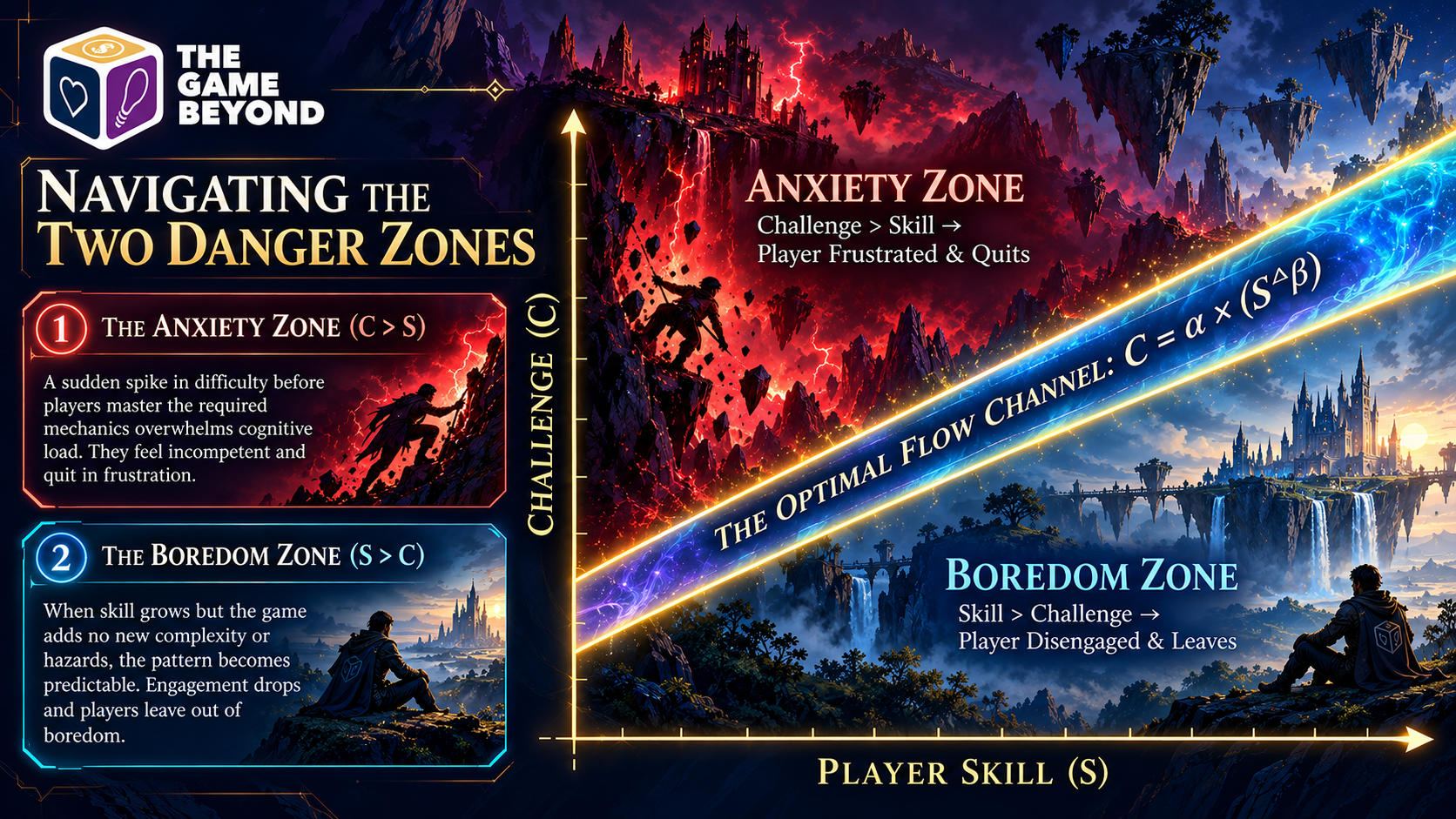
When your game system respects this equilibrium, the player remains inside the optimal Flow Channel.
Navigating the Two Danger Zones
1. The Anxiety Zone (C > S)
When a game introduces a massive spike in difficulty before a player has structurally mastered the prerequisite mechanics, their cognitive load overflows. They experience intense anxiety, feel incompetent, and shut down the game in frustration.
2. The Boredom Zone (S > C)
When a player's skill scales rapidly but the game system fails to introduce new mechanical complexity or environmental hazards, the player's brain recognizes the pattern completely. Dopamine stops flowing, engagement drops, and the player walks away due to sheer boredom.
The Rhythmic Wave of Pacing
A master game designer does not construct a flat, linear difficulty slope. Instead, they design a rhythmic wave curve:
Introduce a New Mechanic: Temporarily spike the Challenge (C) in a safe, controlled environment.
Allow Space for Practice: Let the player experiment until their Skill (S) rises to match the challenge, restoring comfort and confidence.
Pressure-Test Mastery: Introduce a systemic hazard or boss encounter that tests that exact skill combination under pressure.
Provide Rest: Drop the challenge temporarily to give the player a moment of triumph and cognitive recovery before repeating the loop.
This dynamic conversation between system reaction and player action—specifically through balancing loops that prevent runaway momentum or instant failure—is what gives a game its core pulse.
Conclusion: Architecting the Flow State
When you learn to view difficulty as a mathematical curve of cognitive adaptation, you stop guessing why playtesters are struggling and start engineering smooth, irresistible progression loops.
👉 Ready to master systemic pacing, adaptive mechanics, and level calibration? Join The Serious Game Design School and build games that keep players locked in flow.