

Are You Telling a Story, or Are You a Facilitator?
The Revelation: Game meaning doesn't only come from cutscenes. It emerges from the choices the player makes within the rules.
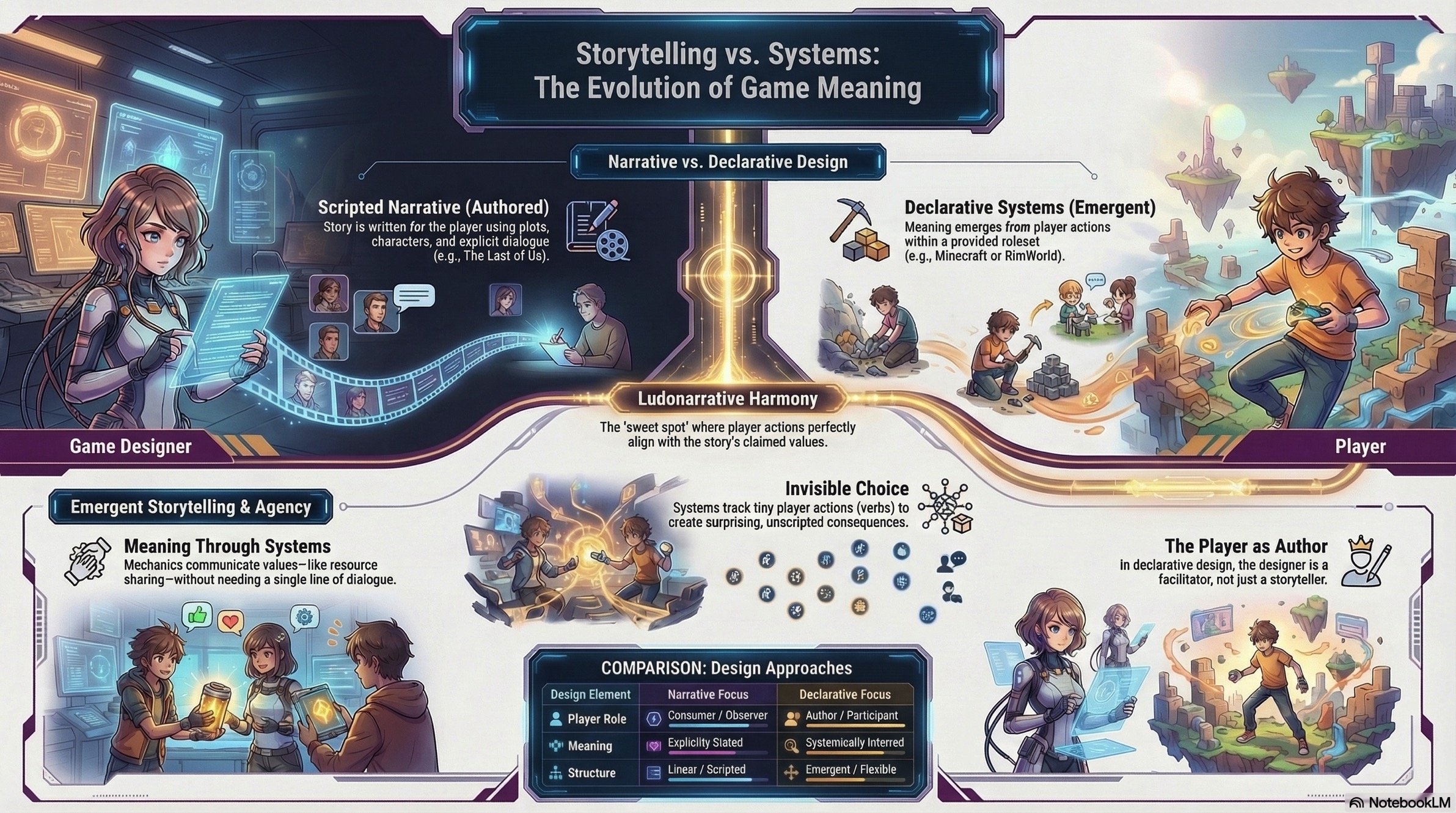
In game design, we distinguish between two types of storytelling:
Narrative Design (Scripted): Think The Last of Us. This is a linear story where the player is an actor following a script. It’s powerful and emotional but offers limited agency.
Declarative Design (Emergent): Think Minecraft or RimWorld. There is no set script. The "story" is what happens when the player interacts with the rules. "I almost starved but then found a hidden cave" is a declarative story.
The Goal: We strive for Ludonarrative Harmony—where the actions the player performs (the mechanics) match the values of the story. If a game tells you "violence is bad" but gives you points for every kill, it has failed.
Takeaway: Great design uses mechanics as metaphors. If you want a player to feel lonely, don't tell them they are alone; give them mechanics that make it impossible to ask for help.
👉 Which player type are you? Take our quick quiz on the school homepage: school.thegamebeyond.com.