5 Critical Mistakes First-Time Game Designers Make (And How to Avoid Them)
Making your first video game is incredibly exciting. But it’s also a minefield. Thousands of beautifully realized game ideas die in development every year—not because the creators lacked talent, but because they fell into the classic traps of beginner game design.
If you want to ensure your game actually gets finished, played, and enjoyed, watch out for these five critical mistakes.
1. Feature Creep (Designing Too Big, Too Fast)
This is the number one killer of indie games. You start with a simple platformer. Then you think, "What if it had crafting? And an open-world map! And multiplayer pet companions!"
Before you know it, you have a sprawling project that would take a team of 50 developers five years to build.
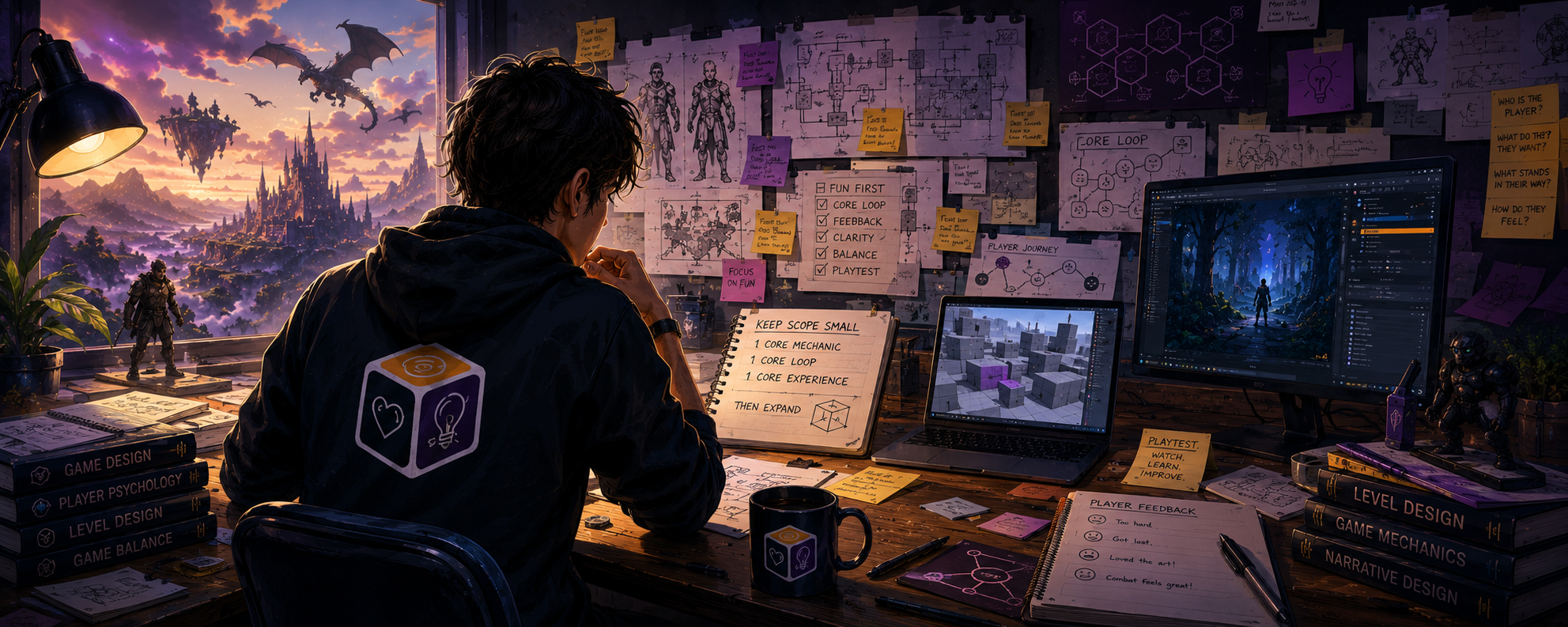
How to avoid it: Force yourself to design within constraints. Ask yourself: What is the absolute bare minimum version of this game that is still fun? Build that first. If you can’t make a game fun with just a character, a jump button, and three platforms, adding a crafting system won't save it.
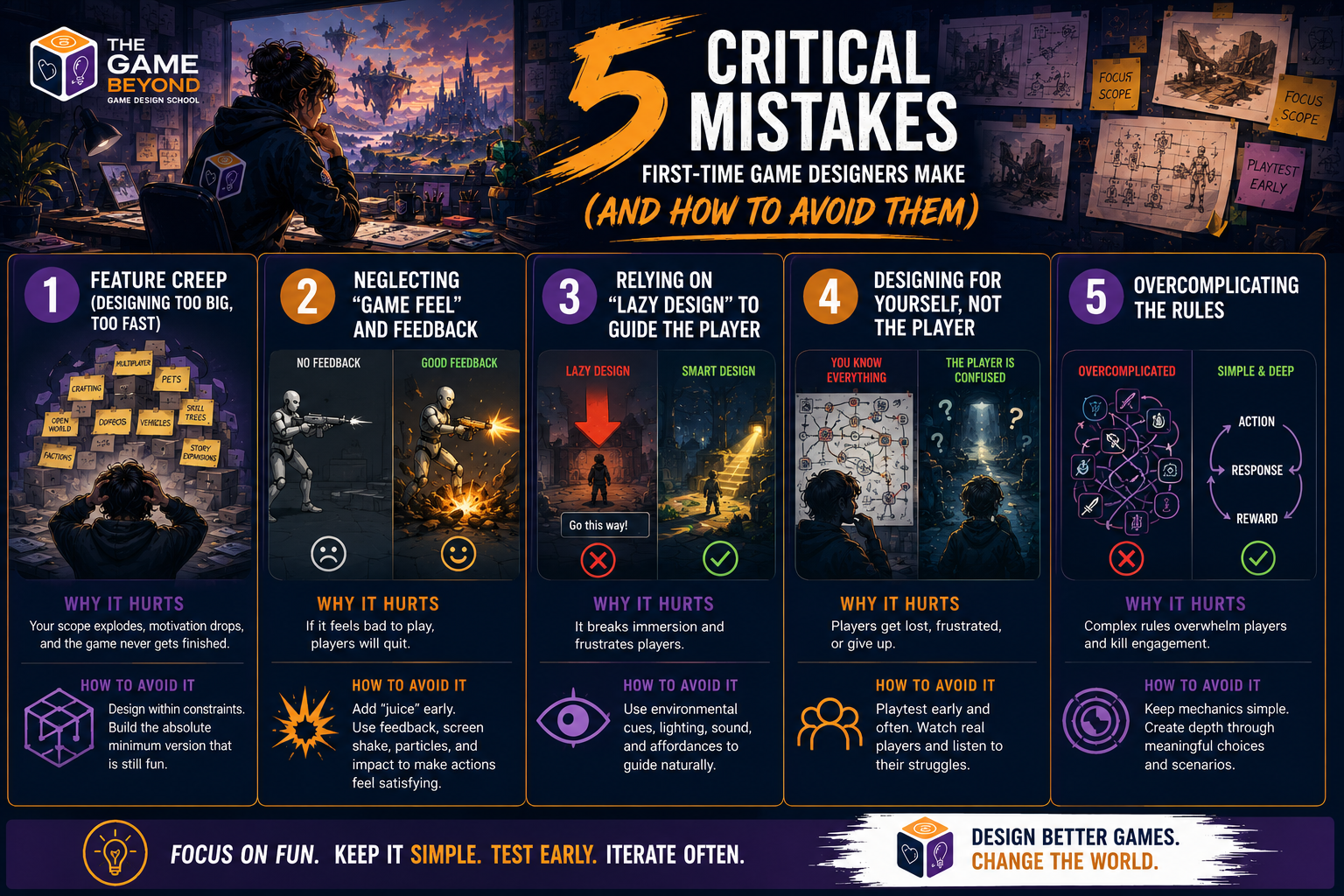
2. Neglecting "Game Feel" and Moment-to-Moment Feedback
Many beginners spend months drawing beautiful assets and writing complex lore, but ignore how the game actually feels to play. If moving, jumping, or shooting feels sluggish, stiff, or unsatisfying, players will quit.
How to avoid it: Focus on "juice" early on. Add screen shake when a player hits an enemy, small particles when they land from a jump, and a micro-pause when taking damage. These tiny visual and physical cues tell the brain that their actions have real weight and impact.
3. Relying on "Lazy Design" to Guide the Player
When a player doesn’t know where to go, a lazy designer places a giant floating arrow on the screen or pops up an annoying text box. This shatters immersion and treats the player like they can't think for themselves.
How to avoid it: Use environmental affordances. If a wall can be climbed, paint it with chalk or wrap a rope around it. Use light to draw the eye, and sound to hint at danger. Trust your players to figure out your world when you give them the right contextual clues.
4. Designing for Yourself, Not the Player
It is easy to design a game that you love because you already know exactly how the mechanics work and where all the secrets are. But when a stranger sits down to play, they don't have your mental map.
How to avoid it: Playtest early and playtest often. Watch a friend play your game without offering any tips. If they fail repeatedly or look confused, it’s not because they are a "bad player"—it’s because your design failed to guide them.
5. Overcomplicating the Rules
Some of the most addictive, memorable games in history have incredibly simple core loops. Look at Tetris, Flappy Bird, or Portal. They introduce a single, elegant mechanic and then explore every possible variation of that mechanic.
How to avoid it: Don’t confuse complexity with depth. True depth comes from simple mechanics interacting in unexpected ways. Keep your controls simple, but make the situations your players face intellectually engaging.
Want to build a rock-solid foundation and bypass these beginner traps entirely? Try our free Game Design Starter Course today and get your design on the right track!