
Is It a Game, or Just a Fancy Digital Toy?
The Revelation: If your "game" doesn't have a specific goal, you haven't made a game; you’ve made a sandbox.
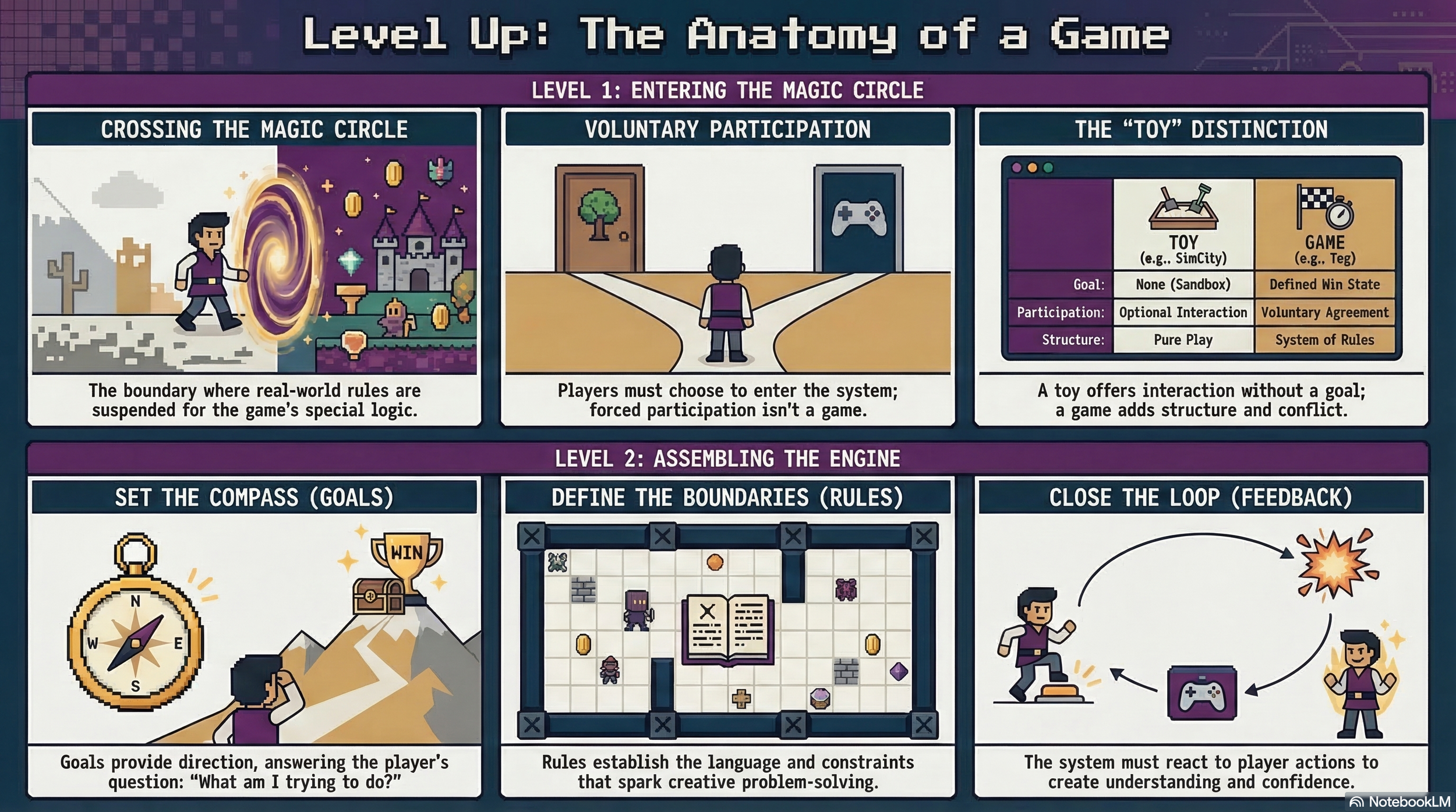
We often use the word "game" loosely, but in design theory, definitions matter. To create experiences that truly grip a player, you must understand the Magic Circle, a concept popularized by Johan Huizinga. It describes the imaginary boundary where the rules of the real world are suspended and the rules of the game take over.
The four pillars that define the Magic Circle are:
Voluntary Participation: Players must choose to enter. If they are forced, it’s work, not play.
Goals: There must be a win state or a clear objective to focus the player's intention.
Rules: These aren't just restrictions; they are the "logic" of the world that sparks creativity through constraint.
Feedback Loops: The system must react to the player's actions in a way that is clear and immediate.
Takeaway: A "toy" (like Minecraft Creative Mode) has interaction but no set goals. A "simulation" (like a flight trainer) has rules but often lacks the "voluntary play" element of a game. To build a true game, you must balance all four.
👉 Need the blueprint for game anatomy? Download our free Game Mechanics worksheet at school.thegamebeyond.com.